
Skip to content
Exposing the Conspiracy Exposing the Conspiracy

Archives: Books


Fabian Freeway

by Rose L Martin (Author), Loyd Wright (Foreword), Joe Wolverton II (Foreword)

The Fabian Society never promised revolution. It promised progress — slow, respectable, and relentless. Rose Martin’s exhaustively documented history of how British Fabian Socialism migrated into the bloodstream of American politics remains the fullest account of that quiet conquest ever written. If you want to understand how policy is shaped without anyone appearing to force it, this is the book that maps the route. …


Global Tyranny … Step by Step

Author: William F. Jasper

Edmund Burke warned in 1784 that people never surrender their liberties except under some delusion. William F. Jasper’s meticulously documented 1992 exposé argues that the delusion of our era has a name, a headquarters in New York City, and a blue flag. Drawing on congressional investigations, presidential speeches, and foundation directives, this is the essential handbook for understanding how national sovereignty is being systematically transferred to an unelected global authority — one treaty, one policy, one peacekeeping mission at a time. …

None Dare Call It Treason

Author: John A. Stormer

First published in 1964 and still in print, None Dare Call It Treason asks a question that official Cold War history prefers to leave unasked: what if America’s losses weren’t accidents but policy? John Stormer builds his case from committee reports, appropriations records, and official statements — documenting how aid, credits, and technology flowed to communist regimes while American soldiers fought their proxies abroad, and how the officials who raised warnings were buried while those who enabled the transfers were protected and promoted. …

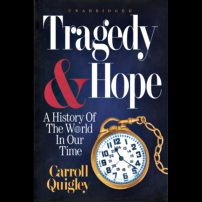
Tragedy and Hope

by Carroll Quigley (Author)

Carroll Quigley was not a critic at the margins. He was a Georgetown professor, Pentagon consultant, and establishment insider who had been granted access to private archives and conversations that ordinary historians never saw. Across 1,300 pages, Tragedy and Hope sets down what he found — how financial dynasties, central banking networks, and private international agreements shaped two world wars, the Great Depression, and the Cold War. It is the one document where an insider recorded, in plain words, how the world was actually governed. It was never meant to reach the general public. …

The Anglo-American Establishment

by Carroll Quigley (Author)

Carroll Quigley was not a conspiracy theorist. He was a Georgetown University historian with access to the private papers of the network he was describing — and he believed its goals were largely admirable. What makes The Anglo-American Establishment so significant is precisely that its author was an insider who chose to document the hidden machinery anyway, because he thought an informed public was preferable to a manipulated one. The secret society Cecil Rhodes launched in 1891 shaped the twentieth century. Quigley names the men, maps the structure, and shows the work. …

The Shadows of Power

by James Perloff (Author)

Founded in 1921 by financiers tied to J.P. Morgan, the Council on Foreign Relations has supplied secretaries of state, defense, and treasury across every administration since Franklin Roosevelt — Democrat and Republican alike. James Perloff doesn’t build his case on rumor. He follows rosters, memoirs, and the Council’s own publications to document how a private club with no electoral mandate has functioned as Washington’s most reliable policy pipeline for over a century. This 2025 edition remains the essential starting point for understanding who actually shapes American foreign policy when the cameras are off. …

The Creature From Jekyll Island

by G Edward Griffin (Author), Peter Klimon (Editor), Carleen Potter (Editor)

In November 1910, seven men boarded a private railcar under assumed names and traveled in secrecy to Jekyll Island, Georgia. What they drafted there became the Federal Reserve System. G. Edward Griffin’s exhaustively documented exposé traces what that system actually is — not a government institution but a banking cartel — how it was designed, who it serves, and how it has functioned as the financial engine behind every major American boom, bust, bailout, and war economy for over a century. It remains the essential introduction to the Federal Reserve and the conspiratorial circumstances of its birth. …

Tower of Basel: The Shadowy History of the Secret Bank that Runs the World

by Adam LeBor (Author)

It has just 140 customers, makes tax-free profits in the billions, is legally beyond the reach of any government or jurisdiction, and has operated at the center of global finance since 1930 — including straight through the Second World War, when it accepted looted Nazi gold and kept channels open between Allied and Axis banking systems simultaneously. The Bank for International Settlements is the central bankers’ own bank, and Tower of Basel is the first serious investigative history ever written about it. What LeBor found in the archives is not reassuring. …

Proofs of a Conspiracy

by John Robison (Author)

In 1797, a Scottish professor of natural philosophy who had spent years moving through the most prestigious Masonic lodges of Europe sat down to document what he had seen. John Robison was not a pamphleteer or a polemicist — he was a Fellow of the Royal Society of Edinburgh and a man who had once regarded the lodges with genuine respect. What changed his mind, and what he documented with scholarly care from Bavarian state papers and German ecclesiastical records, was the evidence that Adam Weishaupt’s Illuminati had not been destroyed by the Elector of Bavaria in 1786. It had gone underground — and kept moving. …

Memoirs Illustrating the History of Jacobinism

by Augustin Barruel

When the guillotine was still at work in Paris, Abbé Augustin Barruel was already documenting how the Terror had been engineered. Drawing on seized correspondence, official reports, and testimony from disillusioned insiders, his Memoirs Illustrating the History of Jacobinism traces three converging conspiracies — against the Church, against monarchy, and against civil society itself — from Voltaire’s circle through the Masonic lodges to Weishaupt’s Illuminati and finally into the Jacobin clubs that directed the Revolution’s violence. Read alongside Robison, whose independent investigation reached strikingly similar conclusions at the same moment, it forms the most powerful contemporaneous case ever assembled that the French Revolution was not a spontaneous popular uprising but a carefully engineered upheaval. …