The origins and purposes of the U.S. Constitution cannot be adequately understood without an appreciation of the Founding Fathers’ anti-conspiratorial mindset. The Founders were steeped in biblical insights about the danger of entrusting power to fallen men. They also recognized that politics — which deals with the struggle to control the state — unavoidably gives rise to conspiracies.
Indeed, the term “usurpation” — which is found frequently in the Federalist Papers and other constitutional expositions published by the Framers — refers to covert efforts to seize power, undermine proper authority, or infringe upon individual rights. Accordingly, the Constitution designed by the Founders was intended to make the government subservient to law, diffuse power among separate government branches, and make those who exercised government power accountable to the governed. Through such provisions the Founders sought to frustrate the efforts of what they referred to as “cabals,” “intrigues,” or “combinations” against liberty.
Because the Founders understood the logic of conspiracy, they were able to anticipate organized efforts to subvert the rule of law, and thus prevent the consummation of such designs. “The freemen of America did not wait till usurped power had strengthened itself by exercise, and entangled the question in precedents,” recalled James Madison in 1785. “They saw all the consequences in the principle, and they avoided the consequences by denying the principle.” Madison insisted that the “first duty” of Americans, in their capacity as citizens, is to “take alarm at the first experiment upon our liberties.” Citizens who display what Madison called a “prudent jealousy” for their freedom will view each such “experiment” as the initial sortie in an organized assault upon their rights. Once again, Madison’s admonition makes sense only if one shares his instinctively anti-conspiratorial outlook on politics.
In his 1789 History of the American Revolution, jurist David Ramsay elaborated upon Madison’s theme, observing that the leaders of the Revolution displayed “that jealousy of their liberties … which they inherited from their forefathers” when they chose to go to war against the mightiest empire on earth over what were, at the time, potential abuses:
The ruled are, for the most part, prone to suffer as long as evils are tolerable, and in general they must feel before they are roused to contend with their oppressors; but Americans acted on the contrary principle. They commenced an opposition to Great Britain, and ultimately engaged in a defensive war, on speculation: they were not so much moved by oppression actually felt, as by a conviction that a foundation was laid, and a precedent about to be established, for future oppressions. [Emphasis added.]
From the modern, statist perspective, the expansion of government power is something that simply “happens,” perhaps in obedience to vast, inscrutable historical forces. The initiatives that Madison and the other Founders would have viewed as “precedents” for oppression are seen by followers of contemporary political fashion as harmless or perhaps even beneficial, because they are generally viewed in isolation from each other. In a specific sense, this approach represents an abdication of intelligence, which is derived from a Latin expression that means “to make connections.” The Founders took care to see how enrichments of state power are connected, and to place them in the context of the struggle to defend liberty from power.
A useful example of this type of anti-conspiratorial analysis was offered by jurist John Dickinson — who was a relatively reluctant convert to the conspiratorial view of Great Britain’s designs — in his 1774 Farmer’s Letters. Using as his model the reign of tyrannical King Charles I, who was impeached by parliament as a “tyrant” and “traitor,” Dickinson pointed out that for opponents of the renegade king, “[royal] acts that might by themselves have been … excused or extenuated derived a contagious malignancy and odium from other acts with which they were connected. They were not regarded according to the simple force of each but as parts of a system of oppression. Every one, therefore, however small in itself, became alarming as an additional evidence of tyrannical designs.”
As the intentions of the British Parliament toward the colonies were made manifest after 1764, the leaders of the American Revolution — particularly John and Samuel Adams, Patrick Henry, Thomas Jefferson, George Washington, and George Mason — applied intelligence to the political events of their time. They were able to see patterns and connections that bespoke evil designs to create a “system of oppression.” Less perceptive individuals might have regarded Parliament’s imposition of new taxes, for instance, as a small irritant to be endured; the revolutionary leaders, as Madison explained, understood the consequences of that imposition, and inferred the conspiratorial designs behind it. But it was their success in educating the public at large about that conspiracy, and mobilizing a critical mass of the colonial population to defeat it, that led to American independence.
Fallen Man, Corrupted Institutions
Conspiracies to pervert government into an engine of plunder and oppression are a natural outgrowth of human nature. Such is “the depravity of mankind, that ambition and lust for power above the law are … predominant passions in the breasts of most men,” lamented Samuel Adams in 1774. He warned that ambitious, scheming men have “in all nations combined the worst passions of the human heart and the worst projects of the human mind in league against the liberties of mankind.” Patrick Henry concurred with this dismal view: “I dread the depravity of human nature…. I will never depend on so slender a protection as the possibility of being represented by virtuous men.” Because rulers are heir to the corruptions that disfigure all men, they are not entitled to the benefit of the doubt in their exercise of delegated power; thus Jefferson admonished that political leaders must be bound down from mischief “by the chains of the Constitution.”
Prior to American independence, the expression “constitution” was used by English and colonial essayists to describe the Anglo-Saxon common-law heritage, with its protections for individual rights and its limitations upon the prerogatives of rulers. It was this tradition that inspired the Founders’ intense suspicion regarding the motives of those who wielded political power. Harvard historian Bernard Bailyn notes that the grievances that inspired the Revolution, and that ultimately resulted in the creation of our constitutional republic, were “centered on a fear of centralized power and rooted in the belief that free states are fragile and degenerate easily into tyrannies unless vigilantly protected by a free, knowledgeable, and uncorrupted electorate working through institutions that balance and distribute rather than concentrate power.”
“Absent justice,” wrote Augustine, “what are kingdoms but vast robberies?” Any government that is freed from the limitations of law degenerates into a criminal conspiracy against the rights of the governed. Dr. Bailyn observes that the Founders shared Augustine’s view, as they regarded government to be “by its very nature … hostile to human liberty and happiness.” While they understood that government is certainly necessary to protect the rights of the law-abiding against the predations of the lawless, they maintained that it exists “only on the tolerance of the people whose needs it served” and that it can be resisted and even overthrown on behalf of a new system of government if rulers exceed their proper jurisdiction.
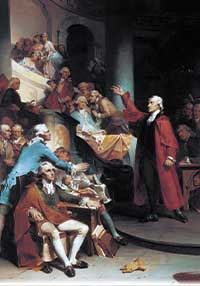
“The leaders of the Revolutionary movement were radicals — but they were eighteenth-century radicals concerned, like the eighteenth-century English radicals, not with the need to recast the social order … but with the need to purify a corrupt constitution and fight off the apparent growth of prerogative power,” comments Bailyn. “Prerogative power” is the opposite of government under law; it is power that is wielded arbitrarily and without accountability to the governed. The “radicalism” of the Founders is best captured in the sweeping statement found in the Declaration of Independence, “all men are created equal” — that is, both those who govern and those who are governed are equal before the law.
This is certainly a “radical” claim from the perspective of those who defend “prerogative power,” who insist that whatever a government does is “legal.” By denying this sinister claim the Founders denied conspirators one of their most valuable weapons: the ability to legitimize their evil designs by carrying them out through the instrumentality of the state.
The Grand Design
The anti-conspiratorial view of the Founders was not based upon abstractions, but was instead a product of their own tangible experience. As the imperial British government moved to usurp their long-established rights to govern themselves — imposing new taxes, quartering troops among them, denying them trial by jury, cutting off their trade — the revolutionary leaders understood that they were confronted with a carefully-wrought design to reduce them to serfdom.
In his Pulitzer-winning 1965 study The Ideological Origins of the American Revolution, Dr. Bailyn concluded that “the fear of a comprehensive conspiracy against liberty throughout the English-speaking world — a conspiracy believed to have been nourished in corruption, and of which, it was felt, oppression in America was only the most visible part — lay at the heart of the revolutionary movement.” Bailyn’s book was the product of a detailed survey of the political writings of America’s revolutionary era, including newspaper essays, broadsides, pamphlets, petitions, and published sermons and speeches. The most salient theme woven through these writings, observed Bailyn, was “a general sense that they [the revolutionary leaders] lived in a conspiratorial world in which what the highest officials professed was not what they in fact intended, and that their words masked a malevolent design.”
“The colonists believed they saw emerging from the welter of events during the decade after the Stamp Act a pattern whose meaning was unmistakable,” continues Bailyn. “They saw about them, with increasing clarity, not merely mistaken, or even evil, policies violating the principles upon which freedom rested, but what appeared to be evidence of nothing less than a deliberate assault launched surreptitiously by plotters against liberty both in England and America.”
Writing on behalf of the pro-revolutionary cause in 1774, John Adams declared that “the conspiracy [against the liberties of the colonists] was first regularly formed and begun to be executed in 1763 or 4….” In an essay published that same year, Thomas Jefferson concurred with Adams’ perception, and pointed out that British policies displayed a conspiratorial pattern. While “single acts of tyranny may be ascribed to the accidental opinion of a day,” Jefferson advised, “a series of oppressions, begun at a distinguished period, and pursued unalterably through every change of ministers, too plainly prove a deliberate and systematical plan of reducing us to slavery.” Once again, Jefferson’s cogent warning illustrates the value of political intelligence — the ability to recognize connections and patterns among supposedly “single acts.”
As previously noted, John Dickinson originally resisted the idea that the rights of the colonists were threatened by a conspiracy. For several years, as Samuel Adams and other “conspiracy theorists” in the revolutionary movement insisted that the growing oppression of the American colonies represented the orchestrated work of concealed enemies of freedom, Dickinson — who was noted for his careful scholarship — insisted that the crisis was a product of accidental miscalculations, rather than organized malevolence. By 1774, however, Dickinson concluded, in phrases that echoed Jefferson’s warning, that “a plan has been deliberately framed and pertinaciously adhered to, unchanged even by frequent changes of ministers, unchecked by any intervening gleam of humanity, to sacrifice to a passion for arbitrary dominion the universal property, liberty, safety, honor, happiness, and prosperity of us unoffending yet devoted Americans.”
The year 1774 also saw the publication of the “Fairfax County Resolves,” which were co-written by “conspiracy theorists” George Washington and George Mason. As a detailed inventory of grievances and a sweeping exposition of political philosophy, the “Resolves” could be viewed as a forerunner of the Declaration of Independence. The document asserted that the American colonists had inherited both the obligations and protections of “the Civil-constitution and Form of Government of the Country they came from,” including “the fundamental Principle of the People’s being governed by no Laws, to which they have not given their Consent, by Representatives freely chosen by themselves; who are affected by the Laws they enact equally with their Constituents; to whom they are accountable and whose Burdens they share…. [F]or if this Part of the Constitution was taken away, or materially altered, the Government must degenerate either into an absolute and despotic Monarchy, or a tyrannical Aristocracy, and the Freedom of the People be annihilated.”
The effort to undermine the British “constitution,” insisted Washington and Mason, was the work of conspirators following a “regular, systematic” plan of oppression: “[T]here is a premeditated Design and System, formed and pursued by the British Ministry, to introduce an arbitrary Government into his Majesty’s American Dominions … [and] to reduce us to a State of Desperation, and dissolve the original Compacts by which our Ancestors bound themselves and their Posterity to remain dependent upon the British Crown….” In describing the labors of that conspiracy, the “Resolves” employed the language of a criminal indictment. The document warns of the “encroachments of despotism and tyranny”; it accuses the British Parliament of undertaking to “extort from us our Money without our Consent” and of following a plan “calculated to reduce us from a State of Freedom and Happiness to Slavery and Misery.” Unless the conspiracy were defeated, warned Washington and Mason, it would “establish the most grievous and invulnerable Species of Tyranny and Oppression, that ever was [imposed] upon mankind.”
Pretexts for Tyranny
There was indeed a plot afoot to usurp the liberties traditionally enjoyed by the American colonists. In Volume III of Conceived in Liberty, his five-part history of the American Revolution, the late Murray Rothbard described the British “grand design”:
The imperial Grand Design, hatched during the French and Indian War and put into effect as soon as it ended, was a comprehensive, many-sided move to subject America to the British Power. The vast new domains captured from France and Spain were to be occupied and administered as benefited a mighty imperial power. The laxity of salutary neglect was to be no more; all the mercantilist laws were to be strengthened and, above all, vigorously enforced; the British army was to overawe the unruly colonials by being stationed in America in force. The British army was to keep the French suppressed, rule the newly-won western lands, and help a network of royal bureaucrats enforce mercantilist restrictions.
“To pay for all this,” continues Rothbard, “the British rulers hit upon a cunning expedient: the Americans themselves were to be taxed for that purpose…. The Americans would thus be caught in a vicious circle of tyranny: the British army was to be stationed in America, largely to enforce unwelcome regulations and taxes upon them, while the major excuse for the unpopular taxes was to pay for the selfsame army.” Those taxes would be imposed by the distant Parliament, in which the colonies had no substantive representation. Legal cases that arose from tax disputes would be heard before British imperial courts rather than by a jury.
Even the most fastidious conspirators usually leave tangible evidence of their intentions, and such was the case with the British grand design. A 1763 letter written by Maurice Morgann, a secretary to Lord Shelburne (president of the British board of trade, which was responsible for many of England’s mercantilist policies), disclosed that while the deployment of British troops to the colonies would take place “under the pretense of regulating the Indian trade,” they were actually being used “to awe the British Colonies.” In fact, rather than protecting the colonists from the Indians, the troops would effectively collaborate with them in this scheme: “[T]he military force on the continent [will] be increased … so that with the aid of a naval force, the whole of the provinces shall be surrounded. The provinces now being surrounded by an army, a navy and by hostile tribes of Indians … it may be time to exact a due obedience to the just and equitable regulations of the British Parliament.”
To colonial leaders who understood the logic of conspiracy, the pretexts invoked by the British ministry were utterly transparent. Parliament “seems determined to fix upon us a large number of regular troops under pretense for our defenses … [but intended instead] as a rod and check over us,” wrote Eliphalet Dyer, a member of the Council of Connecticut, in a 1764 letter from London. Following the passage of the Revenue Act — which appropriated funds for the army of occupation — Dyer urged the colonies to unite in opposition to the conspiracy. Otherwise they would be left to “bid farewell to freedom and liberty, burn their charters, and make the best of thralldom and slavery. For if we can have our interests and estates taken away, and disposed of without our consent … and by those whose interests as well as inclination it may be to shift the burden off themselves under pretense of protecting and defending America,” then the colonists were, in principle, not freemen, but serfs — however seemingly insignificant their present oppressions might seem.
The Constitutional Cure
America’s successful struggle for independence was brought about by principled, anti-conspiratorial leaders who were not willing to concede such usurpations in the vain hope that they would “remain a dead letter.” The Framers of the Constitution also understood that powers that are claimed will in due course be exercised; this is why, once again, they made power subservient to the law and accountable to the electorate.
Dr. Bailyn notes that “the American Constitution is the final and climactic expression of the ideology of the American Revolution” — an ideology that could best be described as “anti-conspiracism.” The document has been described as an “anti-trust act” for political power. It is intended to prevent the consolidation of power in the hands of ambitious men who would use it to destroy individual freedom. While it is true that many who revere and seek to restore our Constitution reject a conspiracy-based analysis of current events, it is clear that the document is a product of the anti-conspiratorial mindset of its Framers. And that fact, in turn, argues for the wisdom of applying such a perspective to present efforts to usurp our liberties and undermine our republican institutions.
The late William Norman Grigg was a senior editor of The New American for more than a decade. This article originally appeared in our April 23, 2001 issue.